
Content note: This article discusses rape, sexual violence and childhood trauma.
We are not sure what to feel today.
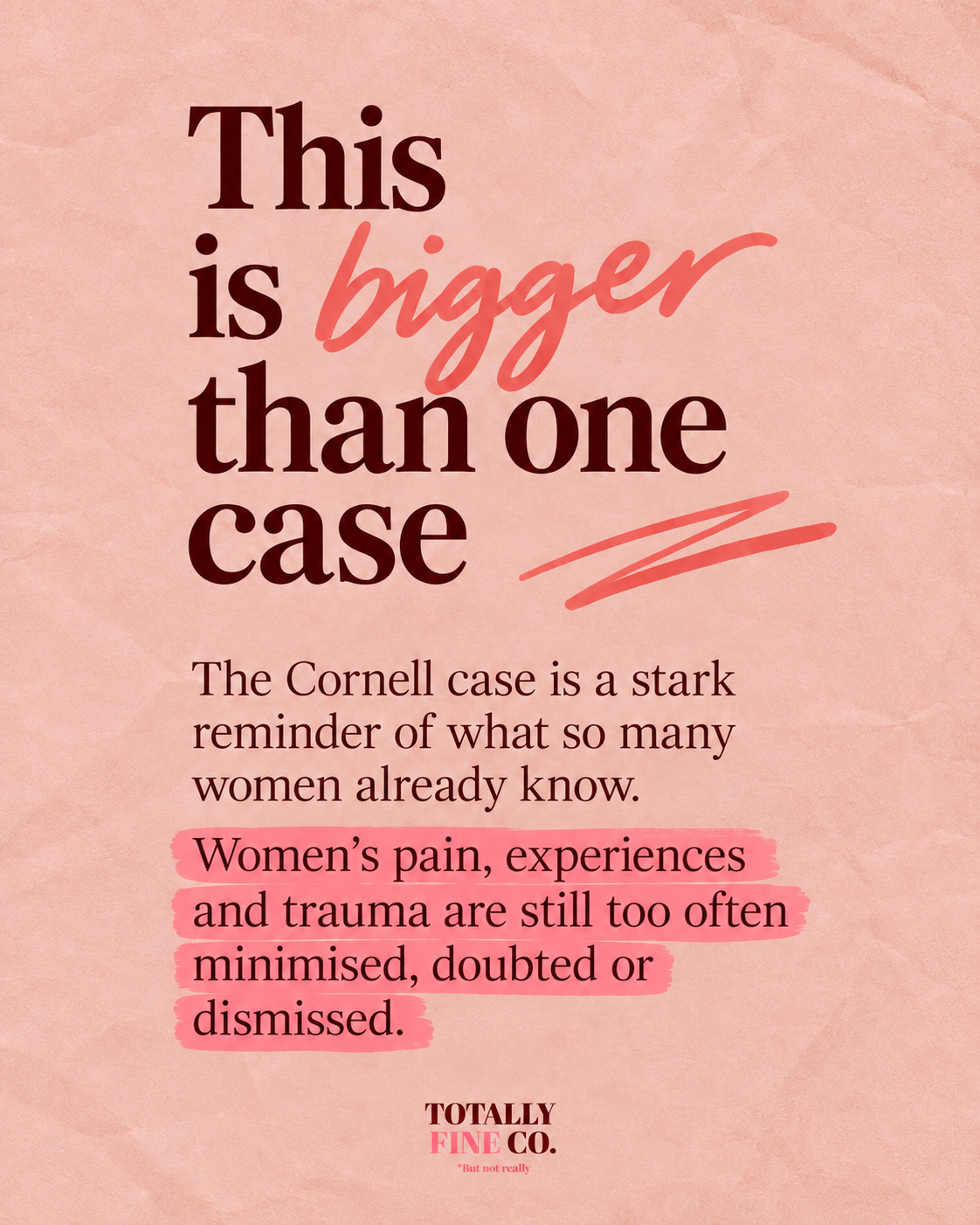
As another horrific rape case circles the tabloids, we are reminded of the stark inequalities women continue to face in all walks of life.
Women are hurt and men are not held accountable.
It is the same every time.
We are violated, but not just once.
We are violated during the act, or acts. Then again in the shame, or in keeping it quiet. Or in the retelling, where we have to explain it and beg to be believed. Then we are violated over and over as our bodies store the trauma and it becomes something we hold internally. We take it within ourselves and it becomes poison that stays with us.
And we are not saying that metaphorically.
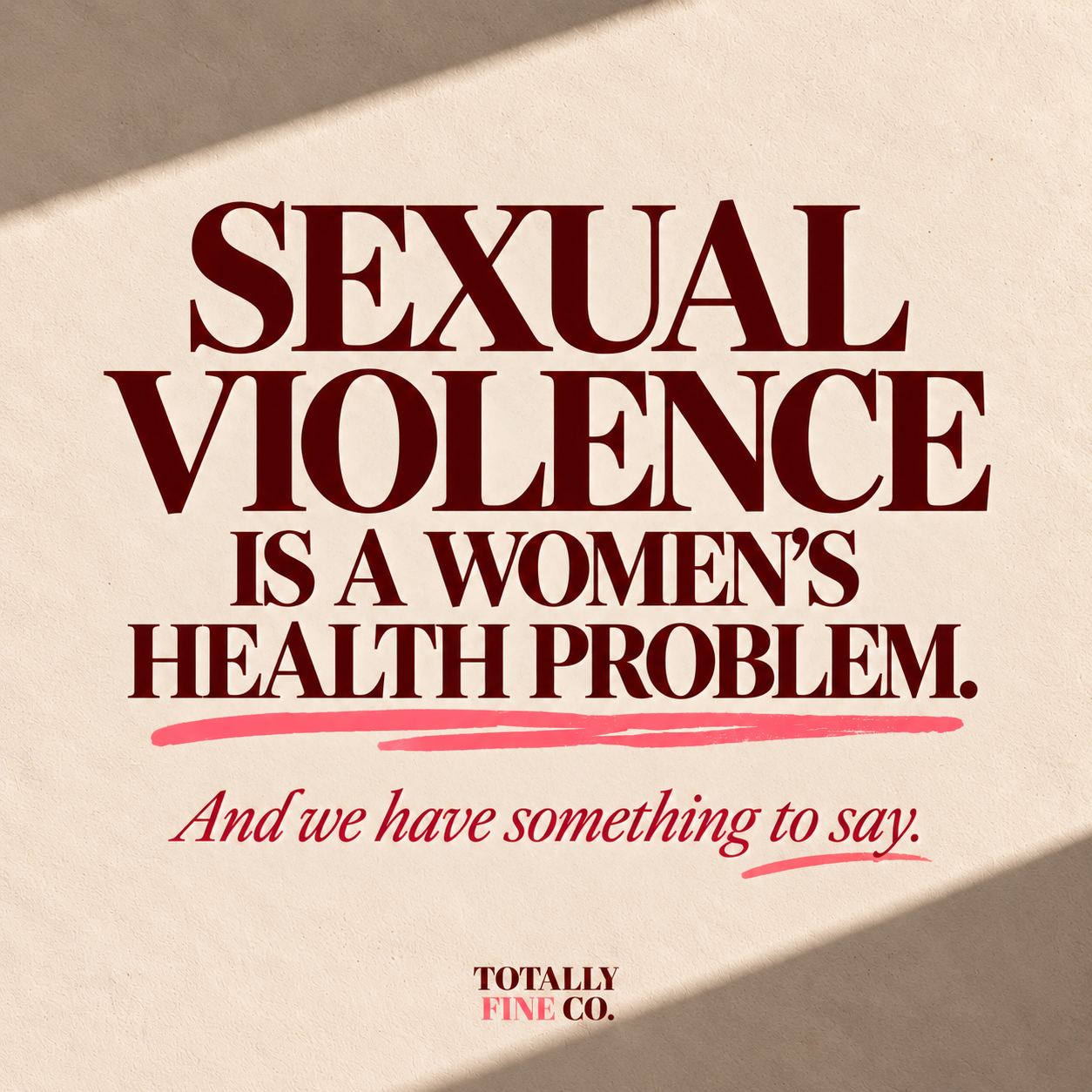
The reality is that sexual violence is a women’s health issue.
And it is a big one.
There is an enormous body of evidence showing that sexual violence and trauma can have lasting effects on physical and mental health. This is not a fringe finding or an emerging theory.
In Australia, more than one in five women have experienced sexual violence since the age of 15. That is around 2.2 million Australian women.[1] Australian longitudinal research has also found that women who had experienced sexual violence were more likely to report high levels of bodily pain, depression and anxiety than women who had not.[2][3] In New Zealand, around 35% of women reported having experienced sexual assault during their lifetime.[6] Keeping in mind these are built on cases reported, there are many many more that are not. This issue is not confined by borders or countires. The World Health Organization estimates that nearly one in three women worldwide have experienced physical and/or sexual violence by an intimate partner, non partner sexual violence, or both.[4][5]
However, prevalence is only part of the story. Sexual violence can leave a health legacy long after the violence itself has ended. The World Health Organization recognises consequences including injury, chronic pain, gastrointestinal and gynaecological problems, sexually transmitted infections, unintended pregnancy, depression, post traumatic stress, anxiety, sleep problems, substance use and suicide attempts.[4] This is supported across decades of research. Meta analyses and systematic reviews have found associations between sexual violence and poorer psychological health, chronic pelvic pain, nonspecific chronic pain, gastrointestinal disorders and broader long term physical health problems.[7][8][9][10] New Zealand population research has similarly found associations between violence against women and poorer general health, pain, physical health conditions and mental health conditions.[11]
The evidence keeps pointing in the same direction.
Sexual violence can affect mental health. It can affect pain. It can affect sexual and reproductive health. It can affect physical health.
Sexual violence is not adjacent to women’s health.
It is women’s health.
These numbers are not small. They are millions upon millions of women. And behind every percentage is a person who has to continue living in the body that something happened to.
This does not mean every survivor will develop chronic illness. It means trauma does not sit neatly outside healthcare. What happens to us can follow us into doctors’ rooms, pain clinics, gynaecology appointments, mental health care and the way we experience our own bodies for years afterwards.
That is exactly why this belongs here. Because if sexual violence can affect women’s bodies, minds and health long after the violence itself, then it makes absolutely no sense to pretend it sits outside the conversation about women’s health.
Yet still we wondered whether we should post this in a business setting.
Is it too raw?
Too vulnerable?
Too political for a brand trying to establish itself?
Is it appropriate?
But we decided we don’t care.
There is right and there is wrong. And this is all sorts of wrong.
When we started Totally Fine Co. and sat down to do our business plan, pick a name and decide who we wanted to be, we asked ourselves what we were and what we felt.
We are young women. Sure. Easy. Who else?
We are young women who have struggled with our bodies. With pain. Mental illness. Weight. Okay. Dig deeper.
We are young women who have struggled with our bodies, with pain, weight, mental illness, sexual and childhood trauma and we are confused, exhausted, frustrated and deeply sad that we have had to carry so much of it ourselves.
When we stripped everything else away, we decided that, overall, what we were was pissed off. And today I feel that more than ever.
We are angry.
We are angry that we have had to spend years navigating our own health struggles just to understand our own bodies.
We are angry every time we speak to our wonderful clients, and all the women we meet, and hear that they have had to do the same.
We are angry that while we pour our literal sweat, blood and tears into building something designed to unwind systemic inequalities and make women’s lives better, shit like this keeps happening.
We are TOTALLY NOT FINE and we are done pretending we are.
We are mad, sad and exhausted that in 2026 we are still living this reality/nightmare.
There may be people who say a women’s health brand shouldn’t speak about rape. There will also be people who are uncomfortable when we say it.
But RAPE.
RAPE.
RAPE.
RAPE.
It deserves to be uncomfortable.
It deserves to be confronting.
If you read this and feel strange, good.
You should.
What we are talking about is unequivocally, categorically wrong, and we are done being quiet or polite about it.
Sexual violence is a women’s health problem.
It is time we draw a line in the sand and say enough is enough.
We have tried really hard to develop our business thoughtfully. To be balanced. To make sure we don’t alienate people, particularly women who may need our help, or the men who are involved in the care of the women in their lives. Supporting women can feel complicated because we don’t want supporting women to be interpreted as hating men, excluding men or being biased against men. Not because men somehow need us to soften this conversation, but because we want people, all people, to be able to come to us and feel safe. We know men are part of this picture too. And a very important part at that. We have had several people tell us to be careful about excluding men for many reasons. But we no longer care if taking a stand alienates some people. Doing the right thing and being open and honest about these issues is more important. There are things more important than business and money.
This is one of them. Men keep commiting viloent acts against women.
Women all over the world are starting to shout from the rooftops, and we want to be standing with those women.
Today, more than ever, we are reminded of what Totally Fine Co. is and what we stand for.
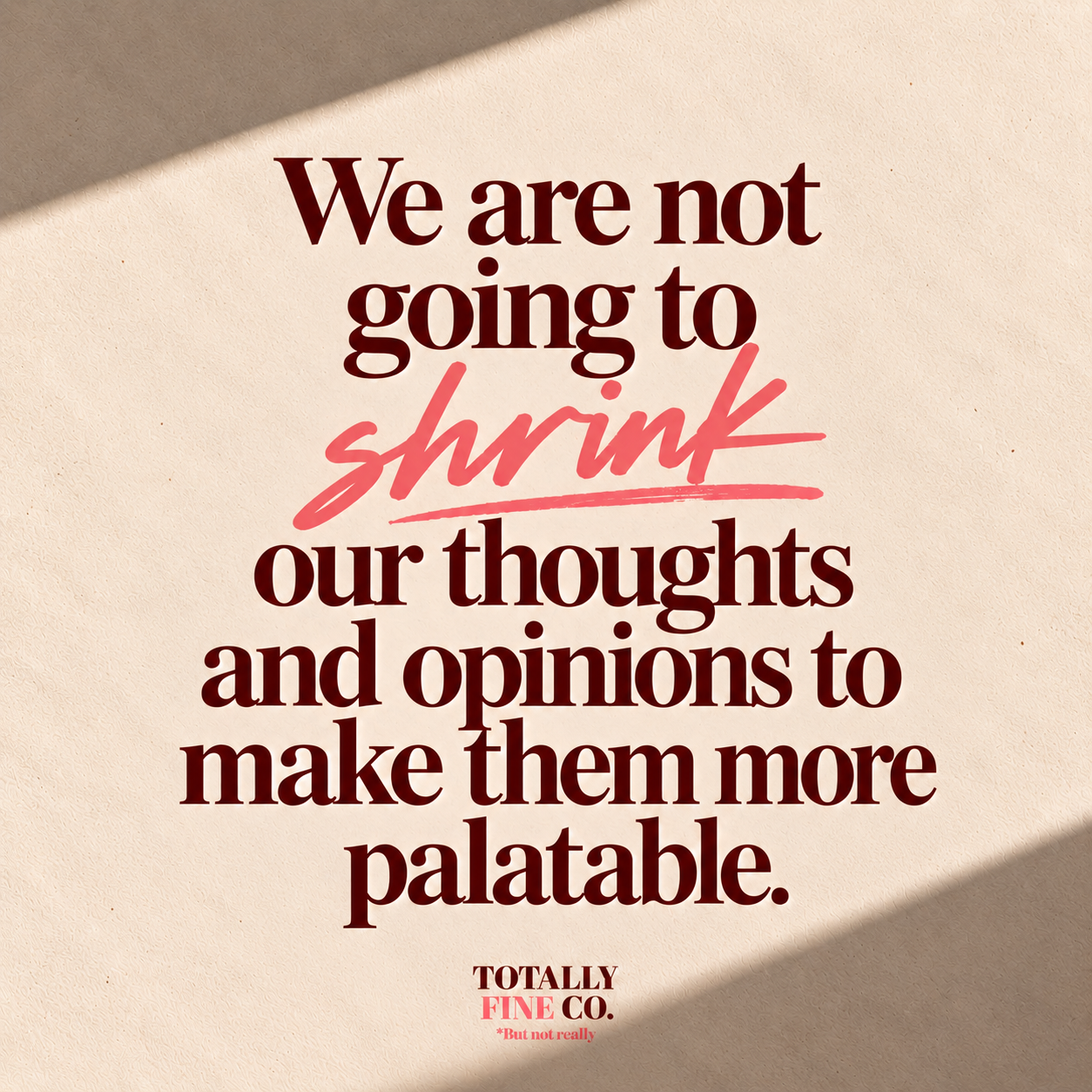
We are not going to shrink our thoughts and opinions to make them more palatable. We are ready to fight for women to be heard. We are going to call a spade a spade. We are going to use the correct terminology.
We are going to say vagina.
Vulva.
Trauma.
Rape.
We promise, in writting, in all branded material, that we will stand up and be loud.
We are not afraid to have difficult converstions.
We listen.
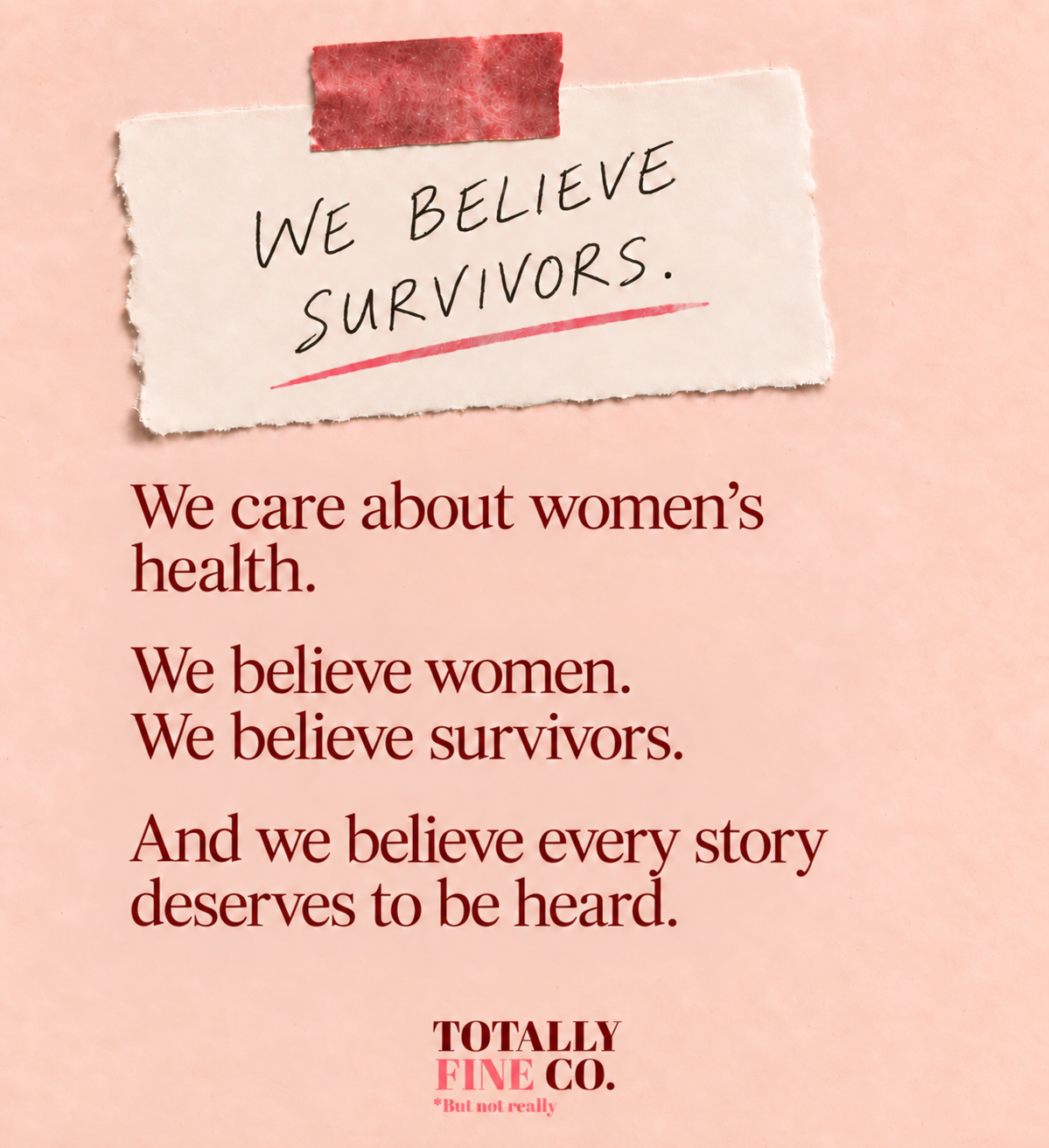
We believe.
We support women.
Support
If this article has brought something up for you, please know there are people you can talk to.
You do not have to be in crisis. You do not have to know what you want to do next. You do not have to be ready to report what happened.
You are allowed to ask for support.
Australia
1800RESPECT
Australia’s national domestic, family and sexual violence counselling, information and support service. Available 24 hours a day, 7 days a week. 1800RESPECT
Call 1800 737 732
Text 0458 737 732
Online chat and video call support are also available 24/7. 1800RESPECT
Full Stop Australia
Free, confidential, trauma specialist counselling for people impacted by sexual, domestic or family violence, as well as people supporting a survivor. Available 24 hours a day, 7 days a week. Full Stop
Call 1800 FULL STOP or 1800 385 578
Online counselling is also available.
Blue Knot Foundation
Specialist trauma support for adults affected by childhood trauma and abuse, including childhood sexual abuse. Support is also available for partners, family members, friends and people supporting survivors. Blue Knot Foundation
Call 1300 657 380
Available 9 am to 5 pm AEST/AEDT, 7 days a week. Phone, email and webchat support are available. Blue Knot Foundation
Lifeline Australia
If you are overwhelmed, struggling to cope or need someone to talk to, Lifeline provides confidential crisis support 24 hours a day, 7 days a week. Lifeline
Call 13 11 14
Text 0477 13 11 14
Online crisis chat is also available 24/7.
If you are in immediate danger or need urgent medical assistance in Australia, call Triple Zero 000. Infrastructure Australian Government
Aotearoa New Zealand
Safe to Talk | Kōrero mai ka ora
Aotearoa New Zealand’s national sexual harm helpline. It is free, confidential and available 24 hours a day, 7 days a week. You can talk with a trained specialist about sexual assault or sexual abuse, ask questions, find local support, discuss medical care or reporting options, or get help accessing ACC funded support through the Sensitive Claims Service. Safe to Talk
Call 0800 044 334
Text 4334
Email support@safetotalk.nz
Webchat and further support are available through Safe to Talk.
Women’s Refuge | Te Whare Rokiroki
For women experiencing family violence or needing help to become safe. Their crisis line is available throughout New Zealand 24 hours a day, 7 days a week. Womens Refuge
Call 0800 REFUGE or 0800 733 843
Live chat and local Refuge support are also available.
Manaaki Tāngata | Victim Support
Free nationwide support for people affected by crime and traumatic events, including their whānau and witnesses. Available 24 hours a day, 7 days a week. Victim Support
Call 0800 VICTIM or 0800 842 846
1737 | Need to Talk?
If you are overwhelmed, distressed or simply need someone to talk to, trained counsellors provide free, confidential emotional support 24 hours a day, 7 days a week. 1737 Digital Hub
Call or text 1737
If you are in immediate danger or need urgent medical assistance in Aotearoa New Zealand, call 111.
References
1. Australian Bureau of Statistics. Personal Safety, Australia, 2021 to 2022. Australian Bureau of Statistics, 2023. National Australian survey data reporting that 22.2% of women had experienced sexual violence since age 15.
2. Australian Institute of Health and Welfare. Sexual violence. Australian Government. Includes Australian Longitudinal Study on Women’s Health findings on bodily pain, sexually transmitted infections, depression and anxiety among women who have experienced sexual violence.
3. Townsend N, Loxton D, Egan N, Barnes I, Byrnes E, Forder P. A life course approach to determining the prevalence and impact of sexual violence in Australia: Findings from the Australian Longitudinal Study on Women’s Health. ANROWS Research Report 14/2022, 2022.
4. World Health Organization. Violence against women. WHO, updated 18 June 2026. Current WHO overview of prevalence and physical, mental, sexual and reproductive health consequences.
5. World Health Organization. Violence against women prevalence estimates, 2023: Global, regional and national prevalence estimates for intimate partner violence against women and non partner sexual violence against women. WHO, 2025.
6. New Zealand Ministry of Justice. 2021 New Zealand Crime and Victims Survey. Ministry of Justice, New Zealand. Reports that approximately 35% of females had experienced sexual assault during their lifetime.
7. Dworkin ER, Menon SV, Bystrynski J, Allen NE. Sexual assault victimization and psychopathology: A review and meta analysis. Clinical Psychology Review. 2017;56:65 to 81. DOI 10.1016/j.cpr.2017.06.002.
8. Paras ML, Murad MH, Chen LP, et al. Sexual abuse and lifetime diagnosis of somatic disorders: A systematic review and meta analysis. JAMA. 2009;302(5):550 to 561. DOI 10.1001/jama.2009.1091.
9. Wegman HL, Stetler C. A meta analytic review of the effects of childhood abuse on medical outcomes in adulthood. Psychosomatic Medicine. 2009;71(8):805 to 812. DOI 10.1097/PSY.0b013e3181bb2b46.
10. Uvelli A, Ribaudo C, Gualtieri G, Coluccia A, Ferretti F. The association between violence against women and chronic pain: A systematic review and meta analysis. BMC Women’s Health. 2024;24:321. DOI 10.1186/s12905-024-03097-w.
11. Mellar BM, Hashemi L, Selak V, Gulliver PJ, McIntosh TKD, Fanslow JL. Association between women’s exposure to intimate partner violence and self reported health outcomes in New Zealand. JAMA Network Open. 2023;6(3). DOI 10.1001/jamanetworkopen.2023.1311.
